

Why Is My RPZ Backflow Preventer Leaking?
A Real RPZ Replacement in Newman Village, Frisco, TX
At a home in Newman Village, Frisco, Texas, the RPZ backflow preventer outside had started discharging water from the bottom of the assembly every time the water supply was turned on. That's the exact situation GPS Plumbing was called to evaluate, and it's a good example of a question a lot of homeowners have: is my RPZ broken, repairable, or does it need to be replaced?
The honest answer is: it depends on why the water is coming out. An RPZ (Reduced Pressure Zone) backflow preventer is a plumbing safety assembly that keeps contaminated or non-potable water from flowing backward into your drinking water supply, and water leaking from it isn't automatically a sign the whole unit has failed.
After evaluating this particular installation, GPS Plumbing replaced it with a new 1-inch Zurn Reduced Pressure Zone backflow preventer. Below is what an RPZ actually does, why one leaks, and what Frisco homeowners should know about repair, replacement, permitting, and backflow testing.
Based on an actual GPS Plumbing service call in Newman Village, Frisco, Texas.
What Is an RPZ Backflow Preventer?
RPZ stands for Reduced Pressure Zone, a backflow prevention assembly that protects potable water from contamination caused by water moving in the wrong direction through a plumbing system.
Normally, water travels one way: from the public supply into the property. Pressure changes can sometimes reverse that direction, a condition called backflow. An RPZ exists to stop that reversed flow from ever reaching the potable water supply.
Inside the assembly are two independently acting check valves, with a relief valve located between them. If the required pressure relationship inside the assembly is disrupted, that relief valve discharges water, on purpose.
That's an important distinction: water coming from an RPZ doesn't automatically mean the relief valve itself is defective. It may simply be doing its job in response to a different problem elsewhere in the assembly or the plumbing system.
Why Would an RPZ Leak?
There's rarely a single cause. Possible reasons an RPZ discharges water include:
- Debris inside the assembly
- Worn or damaged internal components
- A check valve that isn't sealing properly
- Problems with the relief valve
- Changes in water pressure
- Freeze damage
- Corrosion or deterioration
- An aging backflow assembly nearing the end of its service life
The key difference: a brief discharge under certain pressure conditions is normal. An RPZ that continuously leaks, or releases significant water every time the supply is turned on, is not, and because several different problems can look identical from the outside, the assembly needs to be properly evaluated rather than diagnosed by guesswork.
The Newman Village RPZ Replacement
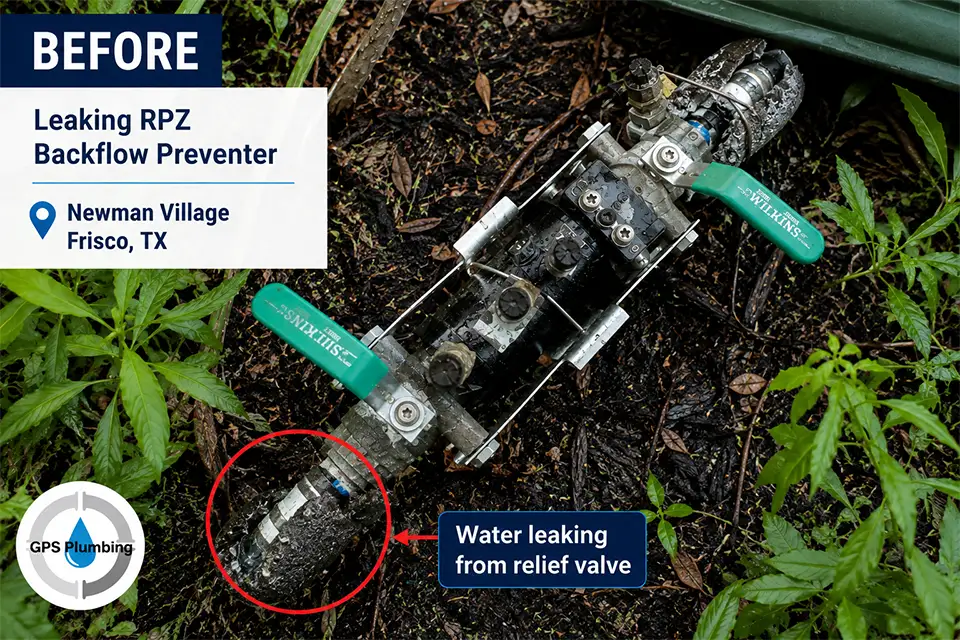
At this Newman Village home, the existing RPZ was discharging water from the bottom of the assembly whenever water was supplied to it. The amount and frequency of the discharge indicated the assembly needed further evaluation, and for this property, replacement was the right call.
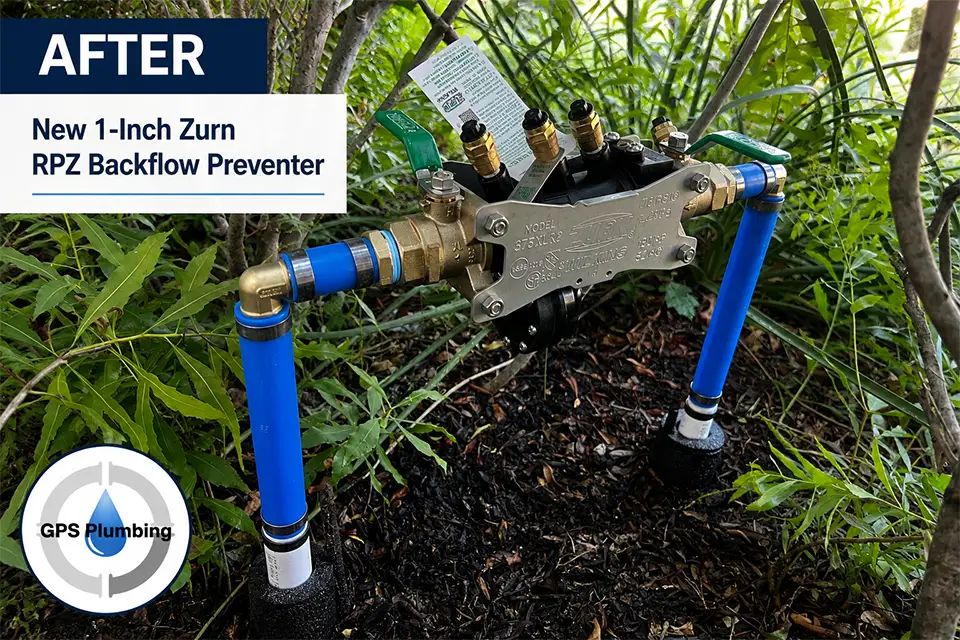
GPS Plumbing removed the existing assembly and installed a new 1-inch Zurn RPZ backflow preventer, along with the necessary piping and connections.
Before
The original RPZ discharged water from the lower portion of the assembly whenever the water supply was turned on.
After
The new 1-inch Zurn Reduced Pressure Zone backflow preventer was installed and connected to the home's existing system.
Why Backflow Protection Matters
An RPZ isn't just another outdoor valve, its job is protecting the potable water supply from backflow and cross-connections. Backflow can happen through backpressure or backsiphonage, and each condition can force water to move in the opposite direction from its intended flow.
That's why a malfunctioning backflow assembly shouldn't be bypassed, capped off, or removed just because it's leaking. The real question is: why is it discharging water, and is it still providing the protection it's supposed to?
Permits and Testing for RPZ Replacement in Frisco, TX
Yes, a permit is required. The City of Frisco requires a plumbing permit before installation of a backflow prevention assembly, and the work must be performed by an licensed plumber registered with the City. An RPZ replacement isn't a simple outdoor valve swap, it's regulated for a reason: it's part of the property's protection against contamination of the potable water system.
Testing is a separate, licensed activity. Backflow prevention assembly testing in Texas must be performed by a licensed Backflow Prevention Assembly Tester (BPAT), certified through the Texas Commission on Environmental Quality (TCEQ). That's a distinct qualification from simply being a licensed plumbing company.
- Frisco requires applicable backflow assemblies to be tested when installed, and annually thereafter
- Testing confirms the check valves and relief valve are functioning correctly
- Exact requirements depend on the specific assembly and application, confirm with your municipality for your property
Who actually performs the test? GPS Plumbing handles the plumbing installation and coordinates the required backflow testing. For this Newman Village project, the certified testing was performed by a separately licensed backflow testing professional contracted for the job. We think homeowners deserve to know exactly who is doing each part of the work, rather than assuming every certification happens in-house.
Signs Your RPZ Needs Attention
Have the assembly evaluated if you notice:
- Continuous leaking
- Significant water discharge
- Water spraying or dumping from the relief valve
- An RPZ that leaks whenever the water is turned on
- Visible corrosion
- Freeze damage
- Broken valves or components
- Unusual changes in water pressure
Continuous discharge can waste a substantial amount of water over time, so ignoring it usually isn't a good strategy.
Repair or Replace?
Whether repair or replacement makes more sense depends on several factors:
- Age of the assembly
- Overall condition
- Freeze or corrosion damage
- Condition of the internal components
- Availability of replacement parts
- Previous repairs and recurring problems
Some assemblies can simply be serviced. Others have enough wear or damage that replacement is the better long-term solution, but that call should follow a proper evaluation, not a guess.
Need Help With a Leaking RPZ in Frisco?
If your RPZ is continuously leaking, dumping water when the supply is turned on, or just doesn't look like it's operating correctly, GPS Plumbing can take a look. The goal isn't to automatically sell you a new assembly, it's to determine what's actually happening, explain what we find, and recommend service, repair, or replacement based on the real condition of your system.
For this Newman Village homeowner, that meant a new 1-inch Zurn RPZ backflow preventer, professionally installed and with certified testing coordinated as part of the job.
Based on an actual GPS Plumbing service call in Newman Village, Frisco, Texas. Permit and backflow-testing requirements should always be confirmed for the specific property and installation.